

Short answer: probably not. A fire pit is unlikely to increase what your house is worth. What it can do is help your house sell ahead of the one down the road — and give you years of evenings you would otherwise have spent indoors. Those are different claims, and almost nobody in this industry separates them
I have spent fifteen years selling fire pits and thirty years selling property. That combination is unusual, and it is why I can tell you that most of what you will read on this subject is written by people who understand fire and have never handled a real estate sale.
The number everyone quotes
Search this question and you meet the same figure repeatedly: a fire pit returns 67 percent of its cost. It appears on retailer sites, in magazine round-ups and in newspaper property sections. Follow it back and there is nothing current underneath it.
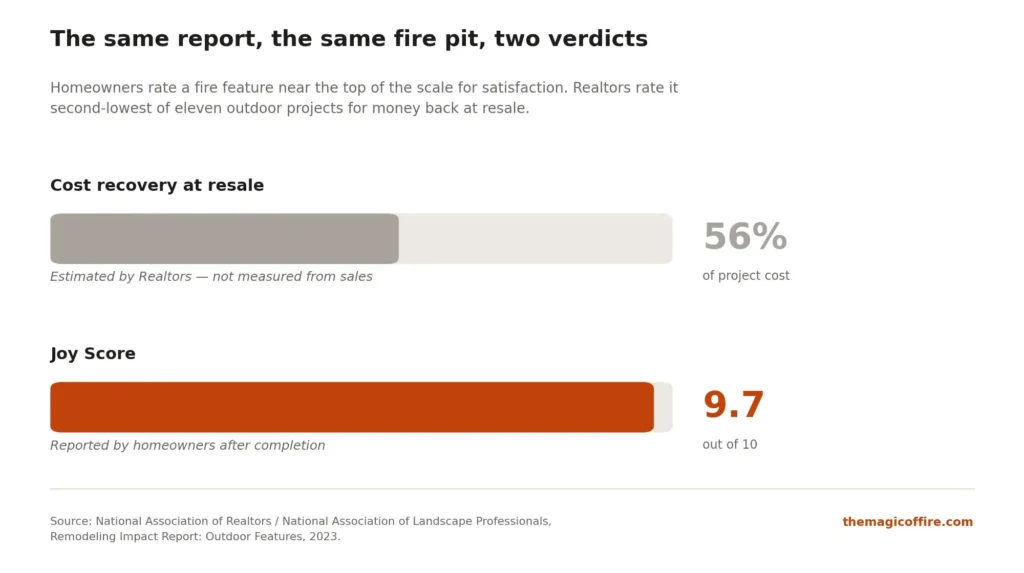
The Remodeling Impact Report: Outdoor Features, published jointly by the National Association of Realtors and the National Association of Landscape Professionals in March 2023, prices a representative fire feature at $9,000 and estimates $5,000 recovered at resale. That is 56 percent.
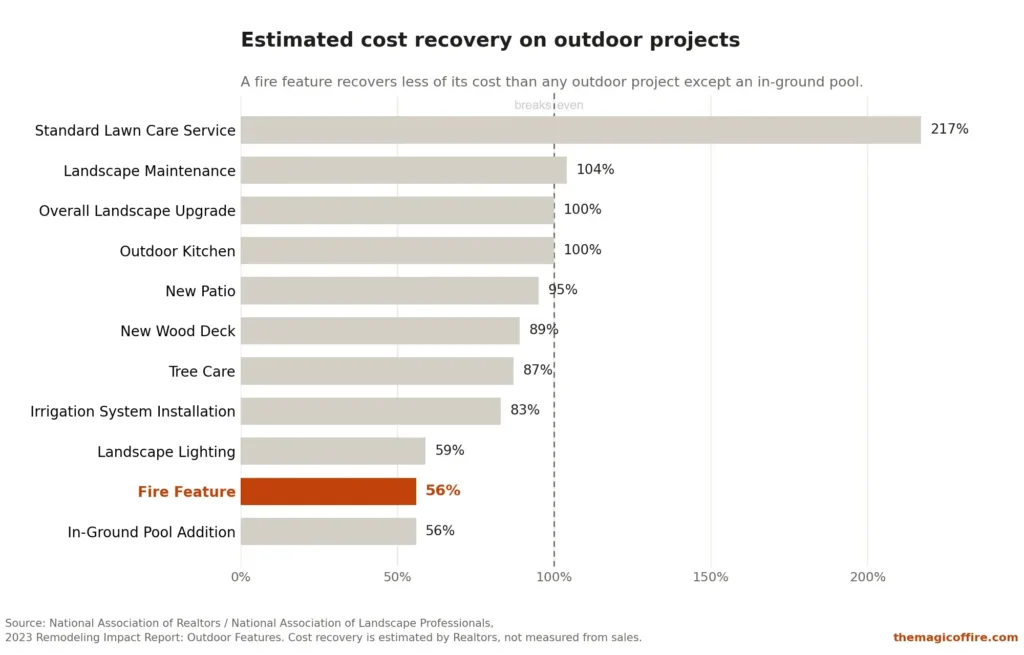
In that report, fire features have the joint-lowest cost recovery of the eleven outdoor projects surveyed — level with an in-ground pool, below landscape lighting at 59 percent, and far below standard lawn care at 217 percent.
So on the most recent industry data, you spend $9,000 and get about $5,000 back. You are roughly $4,000 down.
Why the 56 percent tells you less than it appears to
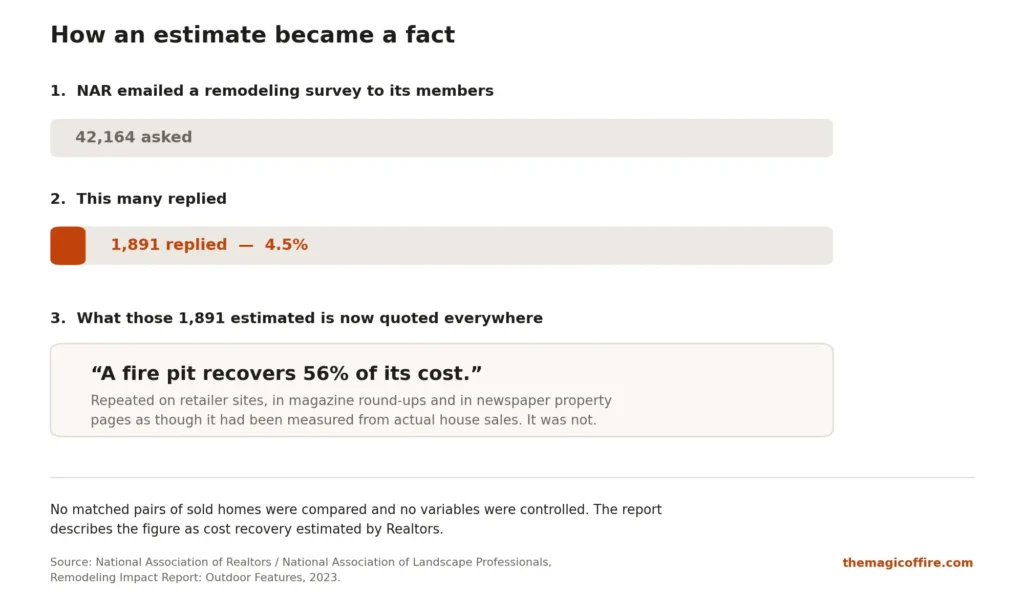
That figure is not a measurement. It is an opinion survey.
NAR emailed a remodeling questionnaire to a random sample of 42,164 members and received 1,891 usable responses — an adjusted response rate of 4.5 percent. The cost figures came from a separate survey of 1,670 landscape contractors that returned 160 responses, a rate of 9.6 percent. The report describes the result as Realtors’ estimated cost recovery, and it is explicit that actual recovery varies with design, materials, location, and the age and condition of the house.
Nobody analysed matched pairs of sold properties. Nobody controlled for anything. The number is what a small, self-selecting group of agents estimated when asked.
I am one of those agents, in effect, and I would not trust my own estimate. Consider what measuring it would require: two genuinely comparable houses, same street, same condition, sold in the same month, identical except that one has a fire pit — and then enough such pairs to say anything statistically. Those pairs do not exist in usable numbers.
Consider also the scale of the thing you are trying to detect. The median existing-home price in the United States was $434,100 in July 2026. A $9,000 fire feature is about two percent of that. Meanwhile the market moves underneath you: national house prices rose 1.7 percent over the year to the first quarter of 2026, while individual metropolitan areas ranged from Honolulu at 11.1 percent to a 2.4 percent decline in Colorado.
The market’s own movement is several times larger than the entire project cost. Isolating a fire pit’s contribution inside that, five years after installation, is not something the survey attempts and not something it could support.
What actually decides a sale
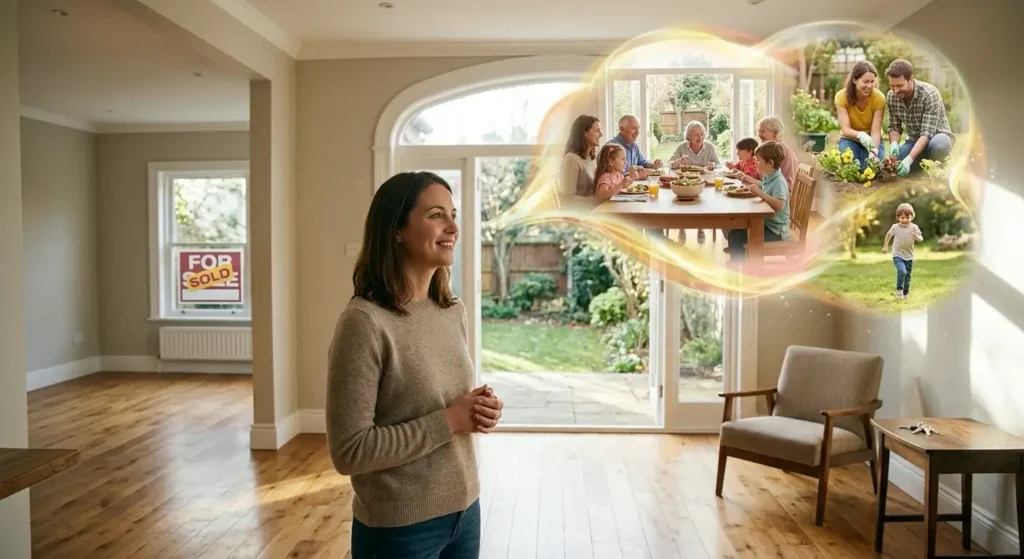
A house sells because a buyer, standing in it, can picture a life there. That decision is made quickly and mostly emotionally, and it is not arrived at by pricing components and adding them up.
Everyone accepts this about kitchens. A house with a kitchen that has been done properly will frequently outsell a neighbouring house with more space and better potential but a kitchen untouched since the nineties. No valuation model captures that, and every agent has watched it happen.
The same mechanism operates outdoors, and there is data pointing at it. Consumer Reports, citing Zillow research, reports that homes whose listings mention a fire pit sold for 2.8 percent more, and 3.8 days faster.
NAR’s own 2023 report contains the concession, in the same tables as the 56 percent: 92 percent of Realtors advise sellers to improve curb appeal before listing, and 97 percent say curb appeal matters in attracting a buyer. Those are statements about how buyers choose between options, not about appraised value.
Which is the distinction this whole subject collapses. A fire pit is unlikely to make your house worth more. It may well make a buyer choose it over the one they saw that morning.
Portable units are not part of the sale
A good deal of advice online distinguishes between built-in features that add value and portable ones that add less. That framing is wrong.
A portable fire pit is a chattel. It leaves with you, along with the furniture and the television. It was never part of what the buyer was purchasing, so it cannot have contributed to the price.
It still earns its keep at viewing stage. A buyer stepping onto a terrace at dusk with a fire bowl lit and chairs set around it is being shown a life, and the impression survives even though the object goes in the van. Sellers are told endlessly to stage the kitchen and almost never told to stage the outside.
Specifying one that survives the sale
Some years ago I owned a kitchen business. A couple came in to design a new kitchen for a house worth several million, which they were preparing to sell. They knew the existing kitchen was dated and were spending a considerable sum to fix it before listing.
We advised a neutral scheme — something that would suit the largest possible share of the buyers they were about to meet. They chose instead a strong, highly personal colour, in the way people do when they are designing a kitchen for themselves rather than for a sale. We could not talk them out of it.
The house sold, at the price they wanted. A month or two later the new owners came into the shop. They liked the kitchen. They could not live with the color. So, they bought a new kitchen!
The lesson transfers directly. The fact of a new kitchen did its job: it removed the objection, the house presented as finished, the sale completed at asking. The specific choices did not survive first contact with the people who bought it. Had the sellers taken the advice, the same sale would have happened and the work would have lasted.
The same applies to a fire feature, and it is where most of the money is won or lost.
Site it where the house can see it. A feature invisible from the main living space contributes nothing during a winter viewing. The good ones sit on an axis from the room where buyers stand.
Match the hardscape. Finishes that pick up the existing paving and walls read as designed. Mismatched materials read as an object someone put down, and buyers register that immediately even if they could not say why.
HPC Fire’s lightweight concrete fire pit collection is offered in six concrete finishes for exactly this reason — matching the existing hardscape rather than reading as something added on.
Run the gas line. A permanent supply reads as part of the house. A propane bottle behind a screen reads as equipment. This is the largest single difference between a feature that feels integral and one that feels temporary.
Keep the specification conventional. Flame pattern, media colour and finish should be the version most people would choose, not the version you would choose. This is the kitchen lesson exactly.
Size it to the space. An oversized burner in a small courtyard is a problem. So is a feature so small it looks lost.
Make sure it lights. Burner sizing, pan design and ignition type determine whether it starts reliably. A feature that will not light on a viewing day is worse than no feature at all.
So should you buy one?
Yes, but for the right reason.
The same 2023 report that gives fire features 56 percent cost recovery also gives them a Joy Score of 9.7 out of 10 — near the top of the scale, from homeowners rating how they felt about the finished project. Both numbers are printed in the same document. The industry quotes the money one.
My position after thirty years is straightforward. Do not buy a fire pit as an investment, because on the available evidence it is not one. Buy it because you will use it. The value isn’t on a balance sheet—it’s in the late evenings spent around the fire with family and friends. But when you build it, specify it as though a stranger will inherit it, and it will do both jobs — the years you own the house, and the day you sell it.
Sources:
- National Association of Realtors and National Association of Landscape Professionals. Remodeling Impact Report: Outdoor Features. March 2023.
- National Association of Realtors. Existing-Home Sales. July 2026.
- Federal Housing Finance Agency. House Price Index. First quarter, 2026.
- Consumer Reports. 7 Yard and Garden Improvements That Boost Your Home’s Resale Value Sept. 2020