

Should you buy a fire pit kit or build a custom fire pit? It’s the question we hear most often at The Magic of Fire before someone places their first order. They’ve seen a gorgeous custom stone fire pit at a neighbor’s house, then priced a kit online for a few hundred dollars, and now they’re stuck. Both options look legitimate. Both could work. But they serve completely different situations, and picking the wrong one wastes either money or time, sometimes both.
This article gives you a straight comparison across the four things that actually matter: cost, complexity, timeline, and code compliance. By the end, you’ll know which path fits your backyard, your budget, and your skill level, and you’ll have a clear next step for whichever direction you choose.
What you actually get with a ready-to-assemble fire pit kit
What’s included and what you still need to supply
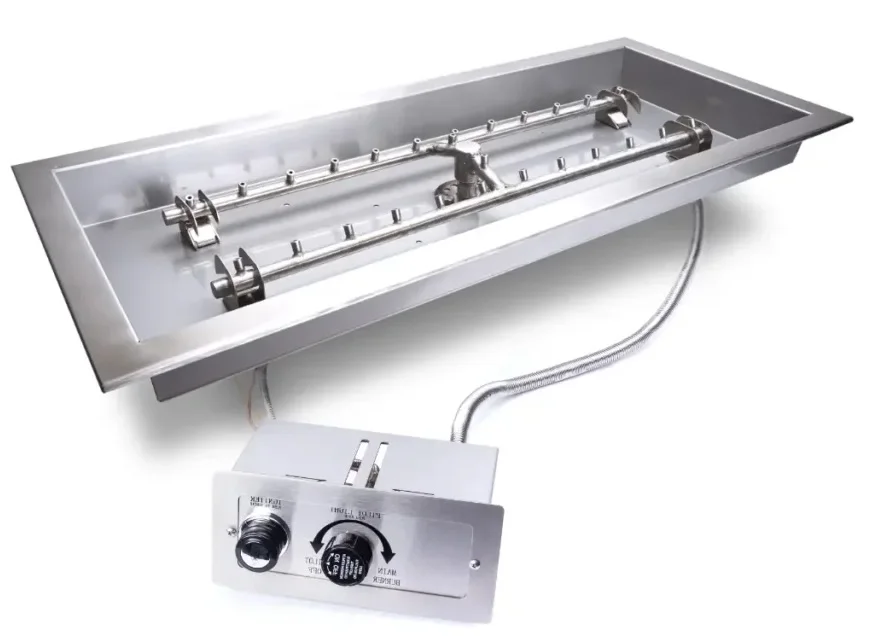
A standard gas fire pit kit includes the functional core of your fire feature: a burner, a pan, and an ignition system. Higher-end kits add fire glass or lava rock to fill the pan. What a kit does not include is the enclosure finish, the gas line connection, or any site preparation. You supply the base structure, whether that’s a concrete pad, a steel enclosure, or a custom-built surround, and you arrange the gas hookup separately.
That distinction matters because people sometimes price a kit and assume it covers everything. It covers the fire part. The rest is still on you, and those costs add up.
If you’d rather not build or supply anything at all, HPC Fire’s Alea Fire Pit is a complete lightweight concrete unit — the enclosure, burner, and ignition all arrive as one finished piece, so there’s no kit to assemble and no structure to build around it.
Real cost range for kit options
Standard gas fire pit kits run from about $200 to $2,500, depending on burner size, ignition type, and brand quality. Entry-level kits are simple match-light setups with smaller burners. At the upper end, complete DIY kits from brands like The Outdoor Plus and HPC Fire Inspired, which we carry at The Magic of Fire, include CSA-certified burners, stainless pans, and electronic ignition systems for $800 to $2,500. The CSA certification on those burners is not just a selling point. It’s what gets you through a gas inspection without a second visit.
For most homeowners building a weekend project with a defined budget, a quality kit in the $800 to $1,500 range covers the fire components completely. The remaining costs come from your enclosure finish and gas connection.
What building a fully custom fire pit really involves
Material choices and what they cost long-term
Custom fire pits are built from a handful of common materials, and each one carries a different maintenance commitment. Regular steel is affordable but needs consistent rust prevention to hold up outdoors. Corten steel forms a natural oxidized layer that protects itself, and a 2- to 3-millimeter corten build can easily last 25 years with minimal upkeep, see this discussion on corten durability for more detail how long a corten steel fire pit lasts. Concrete is durable and permanent but requires sealing and a stable base to prevent cracking. Natural stone and brick are among the most durable options available, but they require solid footings, competent mortar work, and the patience to do that work correctly.
“Custom” isn’t just an aesthetic decision. It’s a commitment to a specific material’s maintenance profile for years to come. Choose the material based on how much upkeep you’re willing to do, not just how it looks in a photo.
Fire pit kit vs. custom build: true cost comparison
Custom masonry fire pits built by a contractor run from $2,000 to $8,000 for the fire pit structure itself. Projects that add seating walls, surrounding hardscape, and gas line work regularly clear $10,000. Even a self-built masonry fire pit carries material costs of $800 to $2,500 before you purchase any gas components. Contractor labor for custom masonry work typically runs $800 to $1,500 for the masonry portion, plus $45 to $100 per hour for a licensed gas professional if natural gas is involved.
These numbers exist to prevent the common situation where someone starts a custom project budgeted at $1,500 and finishes it at $4,000 because the real costs weren’t visible upfront. For additional context on installation cost ranges, refer to a typical industry cost guide on how much it costs to install a fire pit. Know the full number before you buy the first bag of mortar.
Ready-to-Finish (RTF) Enclosures
The Mid-Range Framing Alternative
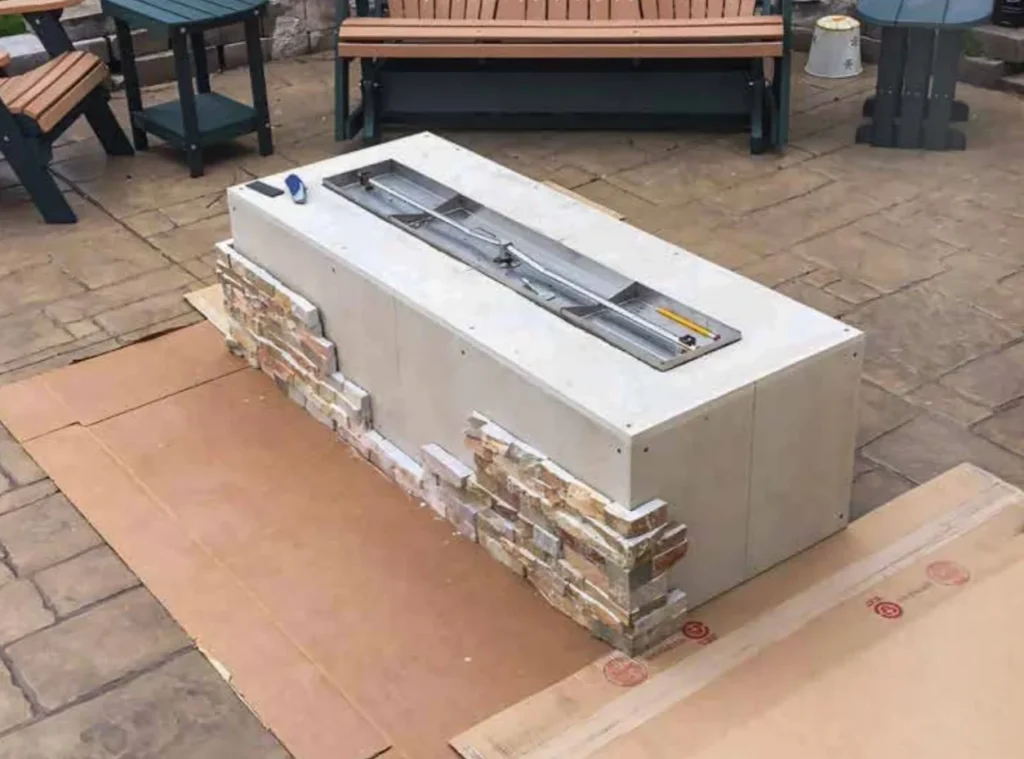
If you want the structural permanence of a custom build without the heavy masonry work, Ready-to-Finish (RTF) enclosure kits offer a massive advantage in speed, typically allowing you to be up and running in just a couple of days. The primary benefit is that most premium enclosure kits come completely turn-key with the gas burner kit and internal pan already supplied and factory-configured. This completely eliminates the guesswork of sizing components and cutting ventilation; your only tasks on-site are to position the framing, connect the gas line, and clad the exterior with your finish of choice, whether that is stacked stone veneer, tile, or stucco.
The main disadvantage is the rigid constraint on layout configuration and upfront cost. Unlike a raw masonry build where you can fluidly alter shapes or add integrated seating benches on the fly, a pre-framed enclosure kit locks you into a fixed footprint. Furthermore, because you are purchasing the engineered frame and the gas components all at once, the upfront price tag is higher than buying individual parts piece-by-piece. It is a premium investment designed specifically to trade a high upfront material cost for a drastically compressed installation timeline.
Should you buy a fire pit kit or build a custom fire pit? The three factors that decide it
Budget and realistic timeline
A gas fire pit kit can be functional in an afternoon. When the base is already in place, installation typically runs 2 to 4 hours. A custom masonry build is a multi-day to multi-week project once you account for gas lines, mortar curing time, and inspections. For most homeowners working with a $1,500 budget and a free weekend, the kit wins on timeline. Full stop.
If budget isn’t the limiting factor and you’re planning a long-term outdoor living space anchored by a permanent feature, the custom path is worth the investment and the wait. But go in knowing the actual timeline, weeks, not a weekend.
Skill level and site constraints
Be honest with yourself here. If you haven’t done masonry work before, a custom stone or brick fire pit is not a good first project. Stacking, leveling, adhesive work, and burner placement all require patience and some prior experience. A kit, by contrast, is designed for someone comfortable with basic tools and a gas connection. If you’re not licensed for gas work, you hire a plumber for that part and handle the rest yourself.
Site constraints are a real factor too. A sloped yard, a small patio, or limited clearance from the house structure usually favors a portable or kit-based approach over a poured or stacked permanent structure. Clearance requirements for permanent built-in gas fire pits typically run 36 inches from combustible materials and 10 feet from structures. On a compact patio, that math may not work for a built-in design.
Permits, codes, and fuel type: the part most people skip
How portable kits and built-in structures are treated differently
Portable and prefab fire pits are generally treated by local codes as recreational fire sources. If you follow clearance rules, supervision requirements, and approved fuel guidelines, most municipalities don’t require a construction permit for a portable unit. Built-in or permanent structures change that calculation. Once you’re pouring footings or connecting permanent gas lines, you’re likely triggering construction review, and sometimes a fire inspection on top of that.
This isn’t a reason to avoid a custom build. It’s a reason to check your municipality before you buy materials. A permit for a built-in gas fire pit typically adds 2 to 4 weeks to your project timeline from application to final inspection, learn more about compliance and permitting for gas fire pits here. Budget for that time, not just the materials.
Gas fuel type adds its own layer of complexity
Wood-burning kits are the simplest permit path, though local burn bans and smoke rules still apply and vary by region. Propane systems are more flexible and work anywhere without a gas line, but propane costs more per unit of fuel and requires proper tank placement and ventilation. Natural gas is the cheapest fuel to run long-term, but it almost always requires a licensed technician for line work and typically needs a permit and inspection. That added cost and process applies whether you’re running gas to a kit or a custom build. The fire feature type doesn’t change the gas line rules.
CSA-certified burners, which are standard in quality kits from The Magic of Fire, are specifically tested to ANSI Z21.97/CSA 2.41, the U.S. standard for outdoor decorative gas appliances. That certification covers ignition performance, gas tightness, combustion quality, and clearance requirements. When an inspector shows up, a CSA-certified burner gives you a clean pass. An uncertified one does not.
The middle path: custom look without the masonry build
When component-by-component assembly makes more sense than either extreme
There’s a third option most people don’t consider until they’re already frustrated with the fire pit kit vs. custom build debate. You can buy individual components, a CSA-certified burner, a stainless steel drop-in pan, a ready-to-finish enclosure, and premium fire glass. Assemble those components and you get a completely custom fire feature without doing any masonry work from scratch. This is exactly how The Magic of Fire’s product line is structured. Buy a complete DIY kit for speed, or spec each component separately to build a design that’s entirely your own.
The enclosure in this approach can be finished with tile, stone veneer, or stucco on your own schedule, independent of whether the gas components are already installed and working. You’re not locked into a kit’s aesthetic, and you’re not hiring a masonry contractor. You control the design yourself with components built to work together.
What this path actually costs and who it’s built for
Component-by-component builds typically land between $600 and $3,000 in parts, depending on burner style, pan size, and the enclosure finish you choose. Drop-in pans start around $113 and run to about $1,000 for larger configurations, if you plan to use a drop-in configuration, this guide on how to install a drop-in fire pit kit is a useful reference. Burners and complete gas component kits cover a similar range depending on BTU output and ignition type. The enclosure finish is a separate cost you control based on your materials and timeline.
This path suits someone who wants a custom aesthetic without pricing out a masonry contractor or committing to a premixed kit design. It gives you the most control without the highest complexity. Start with the burner and pan, spec the enclosure around those dimensions, and finish the exterior on your own schedule.
Your decision checklist before you buy anything
Answer these three questions honestly before you add anything to a cart. They’ll tell you whether to buy a fire pit kit, build a custom fire pit, or take the component path in between. For an expanded pre-purchase checklist, see Things to Consider When Buying a Fire Pit.
What is your real all-in budget?
That means the gas line work, the base preparation, the fire feature itself, and any finishing materials, not just the kit price or the burner cost. Price the full number, including the parts most people forget. Until you have that figure, you can’t make a clean decision between a kit and a custom build.
Is your project portable or permanent?
If it’s permanent or connected to a gas line, check your local codes before you buy materials. Find out whether you need a construction permit, a gas permit, or both. That single step prevents the most expensive surprises in this type of project.
What is your realistic skill level, and how much time can you give to installation?
Be specific. “I’m handy” covers a lot of ground. The relevant question is whether you’ve done masonry or gas-adjacent work before, not just general home improvement projects.
Once you have those answers, here’s where each path starts:
- Kit buyer: Identify your burner size based on your opening dimensions, confirm your fuel type, and verify clearance requirements for your specific patio or yard. The Magic of Fire’stechnical guideswalk through burner sizing, gas pipe sizing, and fire glass quantity with specific calculations, not general ranges.
- Custom builder: Get material bids, confirm the permit requirement in your municipality, and budget a licensed gas professional into the project cost from the start, and reviewThe Fire Pit Structure, What you should knowbefore you commit.
- Component builder: Start with the burner and pan selection, then spec the enclosure around those dimensions. Everything else follows from that order.
The honest answer depends on your situation
So, should you buy a fire pit kit or build a custom fire pit? If your budget is under $1,500 and you want a finished fire feature this season, a quality kit is the right answer. No hedging on that. If permanence and aesthetics matter more than speed and upfront cost, a custom masonry build is worth the investment and the permit process. If you want design flexibility without contractor costs, the component-by-component path sits squarely in the middle and gives you the most control.
Whichever direction you choose, the burner and its certification are the non-negotiable part of the project. Everything else is aesthetic and structural. The burner determines safety, code compliance, and whether your gas inspection goes smoothly or requires a second visit. Don’t cut corners there.
The Magic of Fire carries all three paths: complete ready-to-assemble DIY kits, individual CSA-certified burner components, and ready-to-finish enclosure systems, backed by 36-plus technical guides that cover every step from gas line sizing to fire glass quantity. Figure out your burner size first. Once you know that number, the rest of the project falls into place.