

Should I choose natural gas or propane for my outdoor fire pit? It’s a question that stalls more outdoor fire pit projects than almost any other single decision. Homeowners often spend hours researching burner styles, fire glass colors, and enclosure materials, then hit a wall when it’s time to choose between the two fuels. It’s a consequential choice: get it right and your fire pit fits your property, your habits, and your budget. Get it wrong and you’re looking at a costly retrofit or a setup that never quite works the way you imagined.
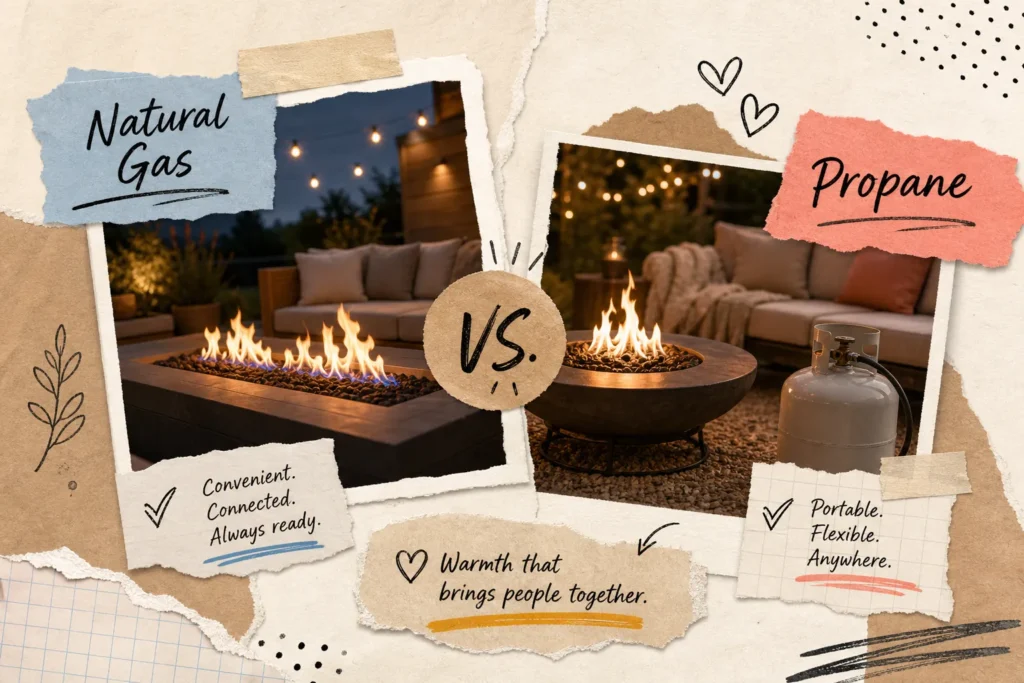
At The Magic of Fire, it’s a question we frequently get asked before any purchase is made. The answer isn’t the same for everyone, but it is logical. Once you understand the differences in heat output, operating cost, installation requirements, portability, and the hardware that connects fuel to flame, the right choice usually becomes obvious. This guide walks through all of it.
How BTU output compares between natural gas and propane
Energy density and what it means for your burner
Propane contains roughly 2,500 BTU per cubic foot. Natural gas contains about 1,000 BTU per cubic foot. That energy density gap is the root of every mechanical difference between the two fuel types, including burner orifice size, regulator pressure, and connection hardware. Because propane is more energy-dense, it requires a smaller orifice to deliver the same heat output, and it burns hotter per unit of gas delivered.
In practice, as a rule, most residential fire pit burners are engineered for one specific fuel, and comparable models across both fuel types typically land in the same rated range: 40,000 to 150,000 BTU per hour. Most patio setups run comfortably between 50,000 and 80,000 BTU. A 20 lb propane tank holds roughly 430,000 BTU of thermal energy, which translates to about 8.6 hours of runtime at a 50,000 BTU setting or 5.7 hours at 75,000 BTU.
Why more BTU doesn’t always mean more warmth.
More BTU doesn’t automatically mean more felt warmth. Wind, seating layout, patio configuration, and burner design all play a significant role. A well-designed 60,000 BTU natural gas burner in a sheltered courtyard will outperform a 75,000 BTU propane unit on a breezy open deck. For small to mid-size covered patios, 50,000 to 60,000 BTU is plenty. Open or larger spaces benefit from 60,000 to 80,000 BTU or more. Fuel type doesn’t dictate which range you need; burner size and your specific environment do.
The real cost of running each fuel type
Propane retail prices run approximately $2.67 per gallon as of 2026, which works out to roughly $2.92 per therm-equivalent when you account for propane’s energy content (91,500 BTU per gallon, compared to 100,000 BTU per therm). Natural gas, priced as a utility, currently averages around $1.63 per therm nationally. Natural gas costs significantly less per BTU delivered, often by 40 to 50 percent depending on your local utility rate.
Upfront installation costs and the break-even point.
The upfront picture is nearly reversed. A natural gas line extension from your home’s meter to an outdoor fire pit location typically costs $833 to $1,020 for the run, with trenching and pipe materials running $14 to $25 per linear foot plus labor and permit fees. A propane tank setup, including regulator, hose, and fittings, typically runs $300 to $950 depending on tank size and whether the connection is permanent or portable. A basic portable 20 lb tank setup is the cheapest upfront by a wide margin.
The long-term math favors natural gas for frequent users. If you’re running a 60,000 BTU fire pit three nights a week across a 20-week season, the per-BTU savings on natural gas add up to real money within a couple of seasons and eventually offset the higher installation cost. For occasional users, say, a few evenings a month, propane’s lower setup cost and tank-swap convenience often win. The break-even point depends on your usage pattern and local utility rates, so it’s worth running the numbers for your specific situation before committing.
Installation requirements, permits, and what each setup actually involves.
Natural gas installation: what to expect.
A natural gas hookup is not a DIY project. A licensed plumber or certified gas fitter extends a gas line from your home’s meter to the fire pit location, installs a shutoff valve within six feet of the appliance, and pressure-tests the completed line before any appliance is connected. The installation is governed by NFPA 54 (National Fuel Gas Code), and the fire pit unit itself must carry ANSI Z21.97 certification. Budget for a building permit plus a gas permit: both are commonly required for permanent installations across most U.S. municipalities, though requirements vary by jurisdiction. For a deeper look at codes, fuel choices, and gas supply planning, see our gas fire pit planning guide.
Propane installation: portable vs. permanent
Propane varies significantly depending on whether you’re going portable or permanent. A portable setup using a standard 20 lb tank connects directly to the fire pit regulator with no trench, no plumber, and no permit required for residential use. Standalone portable propane setups almost never require a permit under residential codes governed by NFPA 58. If you step up to a 50 lb or 100 lb permanent tank with a buried gas line, that installation does require a gas permit and professional installation, same as natural gas.
Before you buy anything, call your local building department. Setback requirements (commonly 10 feet or more from structures), enclosure ventilation specs, and shutoff valve placement rules vary by municipality. Commercial properties typically require permits and inspection for any gas appliance, regardless of fuel type; for information on compliance and permitting specifics for gas fire pits, this compliance and permitting guide is a helpful resource. Getting that call out of the way early prevents surprises mid-project.
Portability, convenience, and where each fuel makes sense.
Propane works best in three situations: you rent and can’t modify the property, your home doesn’t have natural gas service, or you want a fire pit that can move. A 20 lb tank at 50,000 BTU delivers about 8.6 hours of burn time, and refills are available at virtually every hardware store, home improvement center, and many gas stations. Tank exchange programs eliminate the wait for a custom fill. For people who want a fire pit that can migrate from the back patio to the deck to a camping site, propane is the only practical answer.

Natural gas is the better long-term choice for permanent, built-in fire features. It’s always on, never runs empty mid-evening, and costs less per hour to operate. If you already have a gas line running to an outdoor grill or kitchen, adding a fire pit to that run is often a straightforward extension. For homeowners building a permanent outdoor living space they plan to use frequently for years, natural gas removes the tank-management chore entirely.
Not every home has natural gas service. Rural properties, some manufactured homes, and a significant portion of New England states including Maine, Vermont, and New Hampshire have limited or no natural gas infrastructure. Hawaii and Alaska also fall into this category. If your property is in one of these areas, propane isn’t a compromise; it’s the only fuel the infrastructure supports. Check with your local utility before committing to a natural gas setup.
Connection kits, burner compatibility, and the hardware you need.
Why orifice size matters, and why it’s non-negotiable
Natural gas and propane require different orifice sizes. Propane orifices are smaller because propane is more energy-dense and needs less volume to produce the same heat. Natural gas orifices are larger to allow the higher volume of gas required for equivalent output. These orifices are not interchangeable. A propane burner running natural gas produces a weak, inefficient flame. A natural gas burner fed propane is a dangerous mismatch that can produce an oversized, incomplete-combustion flame. Before you buy any burner, confirm it’s engineered for the specific fuel you’re running; our article on how gas fire pits work explains the mechanics in detail. HPC Fire’s lightweight concrete fire pit collection is manufactured in both natural gas and propane configurations, so the fuel choice is made at order time rather than retrofitted later. For manufacturer orifice recommendations, see common gas orifice sizes for outdoor gas fire pits.
Conversion between fuel types is possible on some burners using a manufacturer-supplied conversion kit, which includes the correct replacement orifices, updated regulator, and installation instructions specific to that model. Drilling out orifices as a DIY workaround is not safe and not recommended. If your burner doesn’t have an official conversion kit available, treat the fuel type as fixed.
Choosing the right connection kit for your BTU output
A connection kit is the hardware bridge between your gas supply and your burner: regulator, supply hose, fittings, and shutoff valve. Kits come in three capacity tiers to match different BTU outputs. Low capacity suits decorative burners under 50,000 BTU. Standard covers most residential fire pits in the 50,000 to 100,000 BTU range. High capacity handles large commercial-grade or oversized residential burners above 100,000 BTU. At The Magic of Fire, both natural gas and propane connection kits are stocked in all three tiers, so whether you’re running a compact fire table or a large statement burner, there’s a kit spec’d for your setup. Match the kit to your burner’s rated BTU input, not the dimensions of your fire pit enclosure.
Should I choose natural gas or propane for my outdoor fire pit?
Three scenarios cover most homeowners clearly. If you’re building a permanent fire pit and already have a gas line within a reasonable distance of your installation point, natural gas is the right call. Lower operating cost and zero tank management make it the obvious choice for a fire feature you’ll use regularly for years. If you rent, live in a rural area without natural gas service, or want a fire pit that can move around, propane wins. Low setup cost, no permits for portable configurations, and widespread refill availability make it practical and flexible.
If you fall in the middle, using your fire pit a few evenings a month in a mid-size suburban backyard, either fuel works well. Get a quote from a licensed gas fitter for the natural gas line extension, compare it against the cost of a permanent propane setup, and run the fuel cost math based on your local utility rate versus current propane prices. The numbers will make the decision clear.
Before you buy, answer four questions: Does your property have natural gas service? Is your fire pit location permanent or potentially moveable? How often will you run it per week or season? What is your budget for installation versus ongoing fuel cost? Those four answers point to one fuel type in almost every case.
Making the right call before you buy anything.
Neither natural gas nor propane is the universal winner. Natural gas earns its place in permanent, frequent-use setups where lower per-BTU cost and unlimited supply justify the higher installation investment. Propane earns its place everywhere else: rentals, rural properties, portable setups, and anywhere the natural gas infrastructure simply doesn’t reach.
The bigger risk isn’t choosing the wrong fuel. The bigger risk is mismatching the fuel type to the burner, or buying a connection kit that isn’t rated for your BTU output, leading to poor flame performance or, worse, an unsafe installation. Working with correctly spec’d components, the right orifice, the right regulator, and the right connection kit for your BTU load, keeps both scenarios off the table.
At The Magic of Fire, both natural gas and propane connection kits are available in low, standard, and high capacity, alongside a full lineup of CSA-certified burners built for each fuel type. If you’re starting a new build or adding a burner to an existing enclosure, getting the fuel decision right first makes everything downstream significantly easier: burner selection, gas line sizing, and connection kit choice all fall into place. If you’re still asking yourself “should I choose natural gas or propane for my outdoor fire pit,” browse our connection kits and burner lineup, review our warranties & coverage guide, or reach out to our team for help matching components to your specific setup.