

The orifice is one of the smallest precision components in your gas fire pit system and the one most likely to derail the entire build if you get it wrong. A mismatched orifice produces low, lazy flames, sooty combustion, or in the worst case, a pressure condition that puts the whole installation at risk. Many DIY builders spend hours researching burner styles and fire glass colors, then pick an orifice size by guessing. That’s where things go sideways.
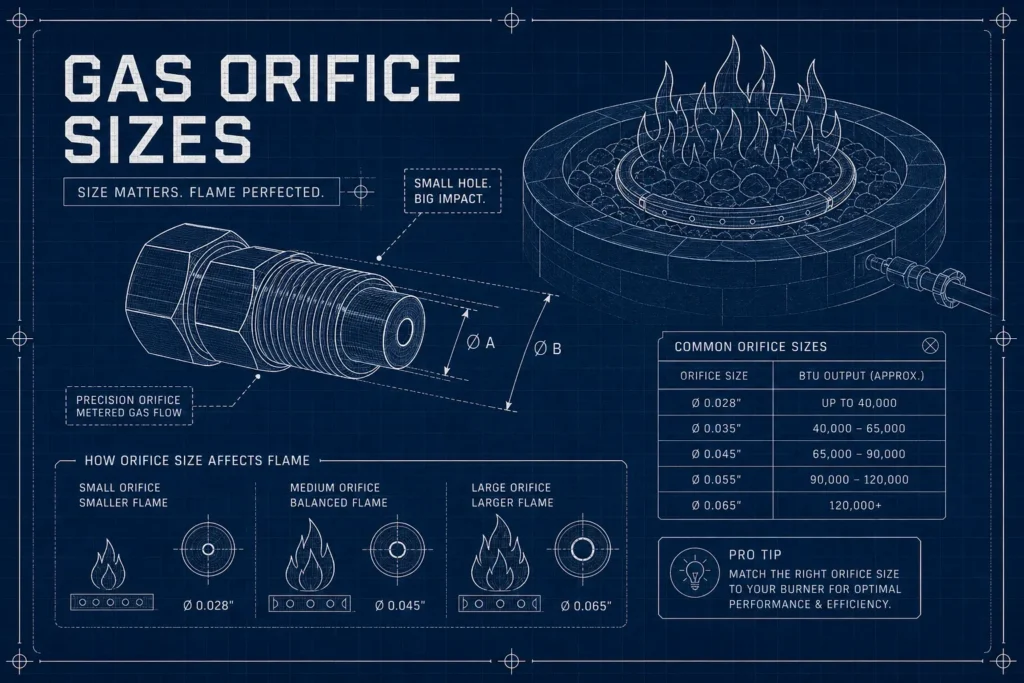
Gas orifice sizes for fire pit burners follow predictable logic once you understand the relationship between drill number, hole diameter, fuel type, and operating pressure. The same framework applies whether you’re sizing a new burner, converting between natural gas and propane, or replacing a worn component. This guide covers that full framework: NG and LP sizing charts, conversion basics, fitting types, and gas line requirements. It draws on the same technical approach behind The Magic of Fire’s library of 36+ fire pit planning guides, where serious builders go to cross-reference burner specs before they buy.
To learn how orifice drill size impacts your overall gas line pressure and fuel delivery, check out our full gas fire pit sizing and supply guide.
What a gas orifice actually does inside a burner
The orifice is a precision restriction point drilled into the gas path upstream of the burner. Its diameter controls exactly how much gas passes through at a given pressure per unit of time, which directly determines BTU output. Think of it as a calibrated bottleneck: a larger hole lets more gas through, a smaller hole lets less through, and the relationship between the two is not linear because flow scales with the square of the diameter. Even a 0.010″ difference in drill size can shift output by several thousand BTU per hour at standard operating pressures, for instance, stepping from a No. 40 to a No. 38 drill on natural gas at 7″ WC moves output from roughly 41,000 to 54,000 BTU/hr.
There are two ways a wrong orifice size shows up in practice. An undersized orifice starves the burner: you get a low, lazy flame with yellow tips and uneven heat. An oversized orifice floods it: sooty flame, incomplete combustion, and potential pressure drop issues downstream. Both conditions are avoidable, but only if you match the orifice to the correct fuel type, supply pressure, and target BTU output before the system goes in the ground.
Gas orifice sizes for fire pit burners: natural gas drill numbers and BTU at 7″ WC
Drill numbers work in reverse of what you’d expect: a smaller number means a larger hole, more gas flow, and more BTU output. Residential natural gas supply pressure is commonly referenced at 7″ water column (WC) for sizing charts, though actual residential supply can vary between roughly 3.5″ and 7″ WC depending on the utility and local conditions. A useful rule of thumb is that one cubic foot per hour (CFH) of natural gas equals approximately 1,000 BTU/hr. That makes the NG fire pit orifice chart easy to read: if you need 50,000 BTU/hr, you’re looking for an orifice that flows roughly 50 CFH at 7″ WC.
The table below covers the most common range for residential fire pit burners. Values are approximate, drawn from published industry sizing charts, and must always be verified against the burner manufacturer’s spec sheet, particularly for CSA-certified burners where rated output is tied to a specific tested orifice. Published charts can differ substantially by manufacturer, so treat these figures as a planning baseline, not a final answer.
| Drill number | Diameter (inches) | Approx. BTU/hr at 7″ WC (NG) |
|---|---|---|
| No. 45 | 0.082″ | ~17,000 |
| No. 43 | 0.089″ | ~29,000 |
| No. 42 | 0.093″ | ~33,000 |
| No. 41 | 0.096″ | ~37,000 |
| No. 40 | 0.098″ | ~41,000 |
| No. 39 | 0.0995″ | ~48,000 |
| No. 38 | 0.1015″ | ~54,000 |
| No. 37 | 0.104″ | ~62,000 |
| No. 36 | 0.1065″ | ~69,000 |
| No. 35 | 0.110″ | ~86,000* |
*BTU values vary across published charts. Some manufacturer sizing guides list No. 35 NG output substantially lower. Verify against your specific appliance’s spec sheet before ordering.
For a clear technical description of how burner orifices function in typical plumbing and gas appliances, see this resource on burner orifices.
Propane orifice sizes for fire pit burners: drill numbers and BTU at 11″ WC
Propane is delivered at higher pressure than natural gas, typically 11″ WC at the appliance after regulation. It also contains more energy per cubic foot. Both factors mean an LP orifice must be smaller in diameter than an NG orifice targeting the same BTU output, with exact sizing depending on manifold pressure, burner geometry, and manufacturer orifice coefficients. As a practical rule of thumb, LP orifices run 25 to 35 percent smaller in diameter than their NG equivalents for the same BTU target. Using an NG orifice on a propane-fed burner will dramatically over-fire the system and create a genuine safety hazard, a common and dangerous fuel-swap mistake.
The LP sizing chart below uses the same drill-number convention. Note that LP charts use a different flow calculation factor than NG because propane has different density and energy characteristics. A No. 35 drill produces about 86,000 BTU/hr on natural gas at 7″ WC but only around 30,722 BTU/hr on propane at 11″ WC. The drill numbers look similar; the outputs are very different. As with the NG table, values below are drawn from published industry sizing charts and should be verified against your burner manufacturer’s tested spec sheet.
| Drill number | Approx. BTU/hr at 11″ WC (LP) |
|---|---|
| No. 45 | ~10,000 |
| No. 42 | ~22,197 |
| No. 40 | ~24,440 |
| No. 37 | ~27,462 |
| No. 36 | ~28,798 |
| No. 35 | ~30,722 |
| No. 34 | ~31,283 |
| No. 33 | ~32,420 |
| No. 31 | ~36,562 |
| No. 30 | ~60,000+* |
*The No. 30 LP value reflects a general progression from published sizing charts. Cite the exact LP chart for your appliance and verify before finalizing your orifice selection.
For a quick manufacturer-focused reference on common orifice sizes and conversion notes, see the Celestial Fire Glass FAQ on gas orifice sizes for outdoor gas fire pits.
Converting between natural gas and propane: size down, not up
The conversion process has a clear direction: moving from NG to LP means a smaller orifice; moving from LP to NG means a larger one. To put a number to that: one manufacturer’s burner documentation shows a 1.30 mm natural gas orifice requires approximately a 0.88 mm orifice for the same output on propane, a meaningful reduction that reflects the combined effect of higher propane pressure and higher energy density. Check your specific burner’s conversion guide for the equivalent figures, since orifice sizing is model-dependent.
The process itself is straightforward. Start with the required BTU/hr for your burner size and style. Pull up the burner orifice drill size chart for the target fuel type and supply pressure. Select the drill size that matches that flow rate. Verify against the manufacturer’s spec sheet before ordering. One detail that catches builders off guard: some burner systems, like smaller Crystal Fire Plus models, require changing both the burner orifice and the valve orifice during a fuel conversion, while larger models may only require adjusting one. Check the manufacturer’s conversion documentation, for example, consult the Crystal Fire burner-orifice references provided by specialist retailers for model-specific guidance, because the conversion documentation for your specific burner is the place to confirm that, not a generic sizing chart.
Pay attention to the regulator as well. Pressure regulators are fuel-specific, and a propane regulator set to 11″ WC cannot simply be repurposed on a natural gas system at 7″ WC. The regulator must match the target fuel type. Swapping orifices without changing the regulator creates a pressure mismatch at the burner and qualifies as a partial, and unsafe, conversion.
Orifice fittings, burner compatibility, and gas line sizing
Two fitting types appear on fire pit burners: flare fittings and NPT (threaded pipe) fittings. Flare fittings seal metal-to-metal on a conical seat; the swivel nut draws the flared tube end tight against the seat. NPT fittings seal on tapered threads, typically with thread sealant on the male side. These are not interchangeable without an adapter, and the wrong fitting creates a leak point at the exact location where gas is pressurized and flowing. Crystal Fire Plus burners, for example, spec a 3/8″ flare on the burner orifice connection and a 1/2″ male flare on the valve connection, details confirmed in the manufacturer’s quick-start guide, which is where you should look before ordering any replacement orifice or NPT flare orifice fitting.
Identifying your fitting type without a spec sheet is straightforward:
- Flare fitting: Look for a swivel nut with a cone-shaped sealing surface where the nut meets the fitting body.
- NPT fitting: Look for male threads that tighten as they screw in, with no cone seat, common on rigid black iron pipe sections and air mixers.
Flexible hose, regulator connections, and many burner orifice assemblies use flare. When in doubt, photograph the connection and verify before ordering a replacement.
Gas line sizing adds another layer. The pipe size you need depends on BTU load, total run length (including equivalent length for fittings and elbows), gas type, and allowable pressure drop. As a starting point for residential fire pits:
| BTU load | Typical line size | Typical pressure strategy |
|---|---|---|
| 50,000 BTU | 3/4″ on shorter runs | Low-pressure NG or 11″ WC LP after regulation |
| 150,000 BTU | 3/4″ to 1″ depending on run length | May benefit from 2 PSI feed with regulator at the pit |
| 300,000 BTU | 1″ or larger on most runs | Typically needs higher inlet pressure, shorter run, or both |
These are starting points, not final answers. Run length matters as much as BTU load, and fittings count as equivalent length in every sizing chart. A 100-foot run with six elbows behaves very differently than a 20-foot straight run at the same BTU rating. Always size from the full gas chart using your specific run length, gas type, and allowable pressure drop before finalizing pipe size, see our detailed Gas Pipe Sizing Charts Explained for Fire Pit Installations for the full tables and worked examples. For another practical field guide focused on residential runs and common install scenarios, consult a third-party gas lines sizing guide.
What to verify before you buy or swap an orifice
Four checks should happen before any orifice order is placed. Run through them in order:
- Target BTU output: Confirm the rated output for your specific burner size and style.
- Fuel type and supply pressure: Verify both at the appliance connection, not at the meter.
- Fitting type: Identify the flare size or NPT thread size from the manufacturer’s spec sheet.
- Drill size cross-reference: Match the burner orifice drill size against the manufacturer’s tested spec, don’t rely on a generic fire pit orifice chart alone.
These four checks apply equally to a new build, a fuel conversion, or a worn-orifice replacement.
CSA-certified burners add an important constraint. The manufacturer has validated the BTU output, fuel type, and operating pressure at which the burner is safe and code-compliant. Swapping in an orifice outside those validated specs voids the certification and can create a code compliance issue when the inspector arrives. The certification number on the burner means something specific: this component, at this orifice size, at this pressure, has been tested and approved. That’s worth protecting.
Putting it all together
Gas orifice sizes for fire pit burners are not a detail to guess at or look up once and assume correct. The drill number, operating pressure, and fuel type must all align for the burner to perform at its rated output safely. The NG-to-LP conversion is where most mistakes happen, because the drill numbers look close but the outputs are not. An orifice that performs perfectly on natural gas will over-fire dangerously on propane at the same drill size.
Before any orifice ships, know your target BTU, your fuel type and supply pressure, your fitting type, and the manufacturer’s tested spec for your specific burner model. Before any gas line goes in the ground, know your total run length including equivalent fitting length, your pipe size requirement at that load, and your pressure strategy. These are not complicated decisions once you have the right reference material in front of you, start with a focused planning checklist such as Gas Fire Pit Planning: The Guide to Codes, Fuel & Gas Supply and cross-check required BTU values with an independent gas fire pit BTU guide.
If you’re building or upgrading a fire pit and want to confirm gas orifice sizes for your specific burner model, The Magic of Fire’s technical guide library and CSA-certified burner lineup give you the documentation to get it right the first time. The guides cover exactly these decisions, matching orifice diameter to BTU, fuel type, pressure, and code requirements, so the finished fire pit performs safely and looks the way you planned. For a practical checklist and common pitfalls when DIY’ing a fire pit, consult 21 Things You Need To Know When DIY’ing A Gas Fire Pit.